Sunday, March 13, 2011

Chicago

In Dominic Pacyga’s Chicago: A Biography ‘Daley City’ we learn the influence one man had over one of the largest cities in America. When Daley began as mayor of Chicago the cities downtown, area faced immense problems because of lack of any investment in the area. Daley shaped major institutions and civic buildings, such as the U.S. Courthouse. He also pushed for there to be a four year state university within the city limits. Many public housing developments had come out of the New Deal, such as Jane Addams Homes and Lathrop Homes. The inner cities hit a major set back though when investments were made in suburbia after the war and not in the downtown area. From the 1940s until today the city has continued to decline in population with many people moving to the out skirts of the city or suburbia. After World War II the city of Chicago just like New York City began constructing high-rise public housing. Although Daley tried to fight, the high-rise plans more then once in Washington, advocating for smaller four-story buildings, they were built anyways. They would later become some of the most problematic areas within the city of Chicago. The housing projects such as the Robert Taylor Homes created massive population density, and the overcrowding soon allow the newly constructed developments to become horrific spaces. In the 1950s housing projects were predominately populated by African Americans, while the suburban areas were mainly Caucasians. Because Caucasian aldermen opposed construction of any public housing in their communities and African American aldermen saw the public housing as a better form of housing and also a solid way to get votes in an area.

With the construction of the Congress Expressway in the 1950s cutting right across the city. “The new system tied the city and suburbs together and cut great holes in the cityscape bringing dramatic demographic changes in its wake.” To describe the expressway construction as cutting holes in the cityscape is visually drastic way of describing the effects that the highway had on the city. Chicago a city that had developed

up because of the railroad was now shifting away from this form of transportation of goods to trucking because of the government’s investment in the country’s highway infrastructure. The construction of the Dan Ryan Expressway continued to segregate the city separating whites and blacks. The expressway was constructed through “poor and working-class white and minority neighborhoods.” The areas surrounding the Dan Ryan Expressway were predominately populated by blacks when it was constructed. In the 1960s, Daley’s support from the black population began to slip with the increasing civil rights movement throughout Chicago and the country.

Photographer Richard Nickel collected photographs throughout Chicago, with an immense focus on photographing Louis Sullivan’s architecture before it was torn down or while it was being torn down. It was clear that Nickel’s found beauty through the photograph of buildings during their “death”.

Wednesday, March 2, 2011

Week 7

In Ed Ruscha, Pop Art, and Spectatorship in 1960s Los Angeles, Ken D. Allan argues thatRuscha's paintings tackle the activity "between the pictorial space, the mental space, and theactual space that structures our encounters with works of art as objects. In Ruscha's Large Trademark with Eight Spotlights we see a representation of a city not through a building but an iconic symbol that very much represents Los Angeles. According to Allan one of the most important aspects to Ruscha's paintings is their ability to require from the viewer a bodily participation. Even Ruscha himself refers to the paintings as friendly characters that he picked up and moved around his studio. To Ruscha the paintings were three-dimensional and he helped create that through painting on the sides where the canvas wraps around the stretch bars and then putting text down the side. The bodily participation was also evoked through things like small details some times at the bottom of the paintingand large text across the top half.
In Flash, L.A. Times, Ruscha employed this technique by painting a very detailed rolled up newspaper that would require the viewer to walk up closely to the painting and maybe even tilt their head. The positioning of the paper gives the impression that the paper is lying on top of the surface, like it is on a table. The text FLASH creates the opposite affect creating a vertical space. It is this horizontal and vertical space in one painting that creates issues of spectatorship. The text in Ruscha's paintings are also strong representations of the billboard
and advertising that had become an integral part of the Los Angeles landscape by the 1960s.
In Standard Station with Ten-Cent Western Being Torn in Half the viewer is still being torn between the vertical and horizontal views. The other quality to this painting is it's comment on the city of Los Angeles's dependency on the automobile and how one was constantly viewing the city landscape from the car. Although the painting still works as an object because of the small comic book in the upper corner creating the horizontal space, making the whole painting seem like a table. It becomes even more clear of Ruscha's concern with ones experience with his work to be a bodily experience with his small books photographs of the vernacular. To look at a book especially as small as Ruscha's books are it becomes a very bodily hand held experience. Ruscha was obviously fascinated with the way one viewed the city of Los Angeles from a car, as in one of his most famous pieces Every Building on Sunset Strip photographs of all the
buildings on sunset strip, are not only taken from Ruscha's car but by the car's motor drive.
In Pop LA Cecile Whiting begins by writing about the highly sexualized qualities of the automobile. Artists Judy Chicago and Billy Al Bengston, and Kenneth Anger all used the shine, the chrome, and physicality of the car to evoke at times erotic imagery, as well as male and female sexual symbols. Edward Kienholz’s approach to using the automobile and sex was not reliant on the shine an chrome of the car, it was reliant on the idea that the car though thought very often to be this place that is private is still can become a very public space. When Whiting writes about Vija Celmins and Ruscha, she acknowledges that they wanted to show the view from the car. Although just as Ken Allan had acknowledged that Ruscha's Standard Station paintings were painted to low to be at the view of the driver, they view was lower to the ground more from the angle of the license plate. According to Whiting, "Ruscha's painting accentuated the features of commercial facades that claim the momentary glance of the driver in transit through the streets of Los Angeles. To me Ruscha's Standard Station paintings shows a much detailed look at the landscape that had become Rushca's home and constant subject matter for his art. Such precise rendering and detail to represent these places and spaces as common place as they were seemed of great concern to Ruscha.
Whiting goes on to compare Ruscha's Twentysix Gasoline Stations to Robert Franks's photograph of a gas station in Santa Fa, New Mexico that appears in his book The Americans. Whiting claims that Franks's gas station photograph is one that shows a pessimistic view of the road, and is a sort of metaphor for diminishing hopes and the entire scene gives off a great sense of loneliness. While Ruscha's photographs are void of any human emotion, with their deadpan style and bleached out skies, the comment on the commercial vernacular within our landscape, not human condition. I am not sure I agree with Whiting here as Ruscha is showing us a human condition of sorts, this was now the American landscape in many places, as common place and repetitive as it was, it was what man had created, and its redundancy alone was depressing.

Saturday, February 26, 2011

Week 6

In Action Around the Edges Douglas Crimp begins by writing about his moving from an apartment in Greenwich Village to one in Tribeca. I was at first confused why Crimp was writing about moving to a new apartment, until a little further into the reading when one learns that the article is all about the reusing of spaces. Crimp was himself moving into a loft that had been converted form a commercial space to a residence. Not only was he himself participating in the reuse of the old industrialized parts of New York City, but also he was concerned with his “spatial implementation” of moving out ofwhat he referred to as the gay scene to the art scene. He felt by surrounding himself with people from the art scene this would allow himself to be more serious about being an art critic. I question this notion that living in an area recognized by society or those within the city as an artist neighborhood, or neighborhood that somehow embodies the art scene makes one more of an artist or knowledgeable about the arts. Crimp himself suggests that his move was a failure of sorts. This notion that the “area” or neighborhood one lives in defines you so thoroughly is one that is very prevalent in Chicago, not that I agree with it. It is widely accepted that the neighborhood of Boys Town is a gay neighborhood, Wicker Park is a hip young neighborhood, that some would consider to be an art scene neighborhood, though it has become less and less of one as years have passed, and new neighborhoods take that title such asPilsen and Bridgeport. What Crimp really focuses on though is the artists’ resourceful use of the industrial areas of New York City in the1970s. Crimp starts with Gordon Matta-Clark’s work and describes it as the city itself, and that he shows the city “simultaneously as neglected and usable, as dilapidated and beautiful, as loss and possibility. Matta-Clark worked with abandoned structures and looked for emptiness within the city that he could use as his canvas of sorts. Other artists that Crimp writes about all have this quality of emptiness of the city, abandonment in their work. Crimp mentions photographers Bernard Guillot, Peter Hujar, and Cindy Sherman who all managed to create an image of New York city that seemed with out people and empty. Then Crimp brings up the work of Louise Lawler who created a sound piece of loud bird like noises that she made when walking through the area near the Hudson River pier to feel safer. This reminded me of Jane Jacobs’s theory that the more people mingling in an area the safer it would be. The pier space that Matta-Clark and other artists were using as their canvases was also a placethat many gay men utilized for a place to sunbathe and cruise. I thought of photographer Doug Ischar’s work Marginal Waters, where he photographed the area Belmont rocks along Lake Michigan in Chicago that was a popular sunbathing spot for gay men in the 1980s. Now the area like the pier in New York has since been destroyed. Culture Class: Art, Creativity, Urbanism begins to discuss the link between art and urbanism. Martha Rosler writes that she is going to explore the position that Richard Florida an urban studies theorist, takes by creating the term “creative class” and how this has played a role in shaping our cities. What Roslar really writes about, in what seems to be an introduction to more writing, is what role culture, particularly the arts has played in shaping the postwar city. Once the industrial parts of the city were unnecessary and the identity of the city itself was no longer that of industry what was it then? This new idenity of the city was not going to be onethat included the working class that had populated the city during the height of industrialization. Cities were now being created to cater to the middle and upper classes. What took place would later be called gentrification, the large purchases of homes in need of remodeling, was a way for neighborhoods to be redeveloped, but this forced out the poor. Many of these areas were perfect for the artist who wanted a large loft space. It is very easy to trace back through the process of gentrification of a neighborhood and see that it begins many times with artists. The idea of artists moving into neighborhoods cities deemed in need ofredevelopment was embraced by city officials as a way to shape a city culturally while driving out the working class and poor.
Though I found Rosalyn Deutsche’s Evictions Art and Spatial Politics, a tough read that I am not quite sure I fully understand I will give this a try. Deutsche is trying to investigate the relationships between contemporary art, space, and political struggles. She goes about doing this by showing how ideas about art are combined with theories on social and public space. In the first section of her book she explores the social function of art within urbanism, and how art is beneficial to the urban environment. Deutsche examines how space is political and the struggle over that space. I was reminded of the project that occurs all over the world once a year called PARK(ing) Day. People go to a metered parking spot in a city and create a park within the confines of the space for people to utilize for the time that it is up. In Deutsche’s essay Krzysztof Wodiczko’s Homeless Projection and the Site of Urban ‘Revitalization’, she looks at how things like parks and historic preservation of buildings were used as disguises of the ugly parts of urban redevelopment, that was really gentrification. She goes on in subsequent essays to discuss the role public art had on public space, such as beautifying, being socially responsible and functional. In her essay Property Values: Hans Haacke, Real Estate, and the Museum Deutsche discusses the work of Haacke’s that was meant to be shown at the Guggenheim Museum is 1971, but was canceled at the last minute. The piece was of photographs of numerous tenement buildings and empty lots in sums of New York City, as well as charts laying out real estate transactions, which showed connections between some of the museum’s board of trustees. Deutsche saw the work’s censorship as an example of the museums’ exclusionary qualities and how institutions such as the Guggenheim have created the slum environment through numerous actions. Not only that but the museum art environment, such as artists, galleries, and the building of museums raised rents in this slum areas forcing people out of their homes.

Friday, February 18, 2011

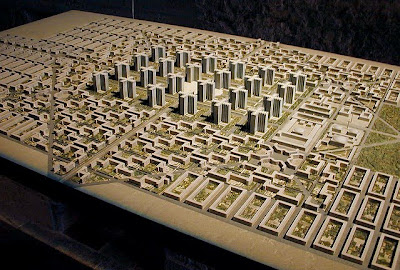
In The Death and Life of Great American Cities Jane Jacobs is not concerned with how a city “ought” to look, she is concerned with how it works. The brunt of her argument is that cities have intricate and diverse uses that give each other mutual support economically and socially. Jacobs breaks up her book in four parts, with the first part focusing on ordinary scenes and events, the social behavior of people in cities. The second part is her argument that economic behavior of cities is the most important factor. Part three is about decay and regeneration, how cities are used, how cities and the people in them behave in real life. The fourth part is about the problems that cities create and suggests for changes in housing, traffic, design, planning, etc. Although Jacobs writes that the most important part of her argument is the economic and social behavior of cities, it is clear that one of the most important factors to Jacobs is REAL LIFE. Jacobs writes in her introduction that unsuccessful city areas that do not have the mutual support economically and socially and “ that the science of city planning and the art of city design, in real life for real cities, must become the science and art of catalyzing and nourishing these close-grained working relationships.” It is the lack of urban planners and anyone else involved in the development of great cities observing how real cities function well and how real life functions with the cities that Jacobs calls out. Jacobs uses a brief example of a housing project’s grass in New York and how everyone hated the grass who lived there because it was an illusion that all was well with the housing project when it really wasn’t. When developers built the place they never asked the people who were going to live there what they wanted, again the lack of dealing with real life. Jacobs then goes on to list people who have had the greatest impact on city planning theory such as Ebenezer Howard, Sir Patrick Geddes, the Decentrists (Lewis Mumford, Clarence Stein, Henry Wright, and Catherine Bauer) and Le Corbusier. Howard’s did not like cities and his ideas for them according to Jacobs were city destroying. Howards Garden City model that was also embraced by the Decentrists, was to thin cities out, de-center them, create smaller separate cities or even towns. Streets were bad, people should never be on them, commerce and residence areas should always be separate from each other, and the city should be self-contained and never change or grow. Jacobs claims that the Decentrists only looked at the failing parts of a city and nothing else, which left them with no understanding as to how a successful city would look and work. Although the Decentrists were against Le Corbusier, he also adopted some of Howards’s Garden City ideas in his Radiant City, a “vertical garden city.” Le Corbusier’s vertical city was a city of towers with green all around and it embraced the unchangeable aspect of the Garden City plan. Le Corbusier felt that skyscrapers were the answer to the problems of cities. Many of these ideas became plans for low-income public housing. In many of the city of Chicago’s public housing developments, such as Cabrini Green, Robert Taylor Homes, Henry Horner Homes, and Harold Ickes Homes, the city embraced the high-rise building surrounded by green, and island off. All of these public housing plans have been deemed as failures that segregated low-income families off from the rest of the city, fostered gang activity, and created dangerous living environments. Today almost all are torn down and some are in the process of redevelopment in to smaller town homes with mixed income within the same space. The Garden City of the Decentrists and the Radiant City of Le Corbusier has had a great impact on the city of Chicago. Jacobs also claims that when she wrote the book in the 1950s city planners were combining the two plans to create cities and that this was a mistake. In Jacobs’s chapter The Curse of Border Vacuums, she discusses how borders function in cities. Jacobs claims that massive single uses in cities create borders and those borders are damaging for neighborhoods in cities. Jacobs is concerned not with the social results of borders, but the physical and functional effects of borders on their direct surroundings. Things she lists as boarders are train tracks, waterfronts, big-city university campuses, civic centers, hospital grounds, and large parks. Since all of these types of boards she lists are not necessarily noisy unattractive, or undesirable of a location, there must be another reason that blight develops around these boards. Jacobs says that these boards form dead ends and walls for those who use city streets. She claims that for streets to stay safe there must be a constant mingling of people within these places for different reasons. The evidence Jacobs provides for this is an article published in the New York Post around the time she was writing the book, about a murder in an area that had become increasingly vacant once the construction of the Cross-Bronx Expressway began. Jacobs saw the construction of the Expressway creating lesson of a reason for people to go to that border causing fewer people to mingle in the area, causing shops to close early. Jacobs divides all land in to two types general land and special land. General land is anywhere people circulate on foot in public, streets, small parks, and maybe building lobbies used like streets. Special land is not for public passage; people walk around it or next to it, it is technically in the way. A person circulating on foot in public is either not allowed in this special land or does not care to enter it, such as homes or places of work. Although special land contributes the people for general land, it also interferes with it. The evidence that Jacobs provides is a term used by downtown merchants “dead place” a place that goes empty on a downtown street. A dead place causes significant loss in foot traffic in the area around it because there is no use for it, and no reason for someone to go in to it or even go near it. This causes a “geographical obstacle to the general land.” Again, Jacobs shows when a border has only a single use than less people will come to it and mingle. Jacobs’s approach to correcting these single use borders is to create a seamless border. She suggests that parks should not put their activities such as ice-skating rinks in the center of the park but on the border. Then with corporation of the areas next to this border create something like a cafe or a place to rent skates in the area across from the border. This approach will allow for a seamless border that will help create multiple uses. Robert Moses In Robert Fishman’s Revolt of the Urbs the argument is that Moses’s critics of his plan to put a highway through Washington Square Park led to the larger debate on American Urbanism. One sees how Robert Moses convinced the public that he knew what was best for them, which was usually a massive clearing of any section of land that happened to be in his way for his great bridges, highways, expressways, and even parks. Moses forced relocation for numerous people who he saw as in the way of his projects. The battle to build a highway through New York’s Washington Square Park in the 1950s is where Moses met his greatest opposition, particularly that of Jane Jacobs. Moses wanted to build a highway through the park linking to his Lower Manhattan Expressway. This goes against everything Jacobs writes about in her chapter on boarders. According to Jacobs’s theory on borders, the highway would create more borders and fragment the park into single use pieces, which would diminish mingling of people in that area. The issues Jacobs and others bring up that were against Moses’s ideas were that diverse neighborhoods were at the heart of a city, pedestrians and mass transit should be focused on over the automobile, the importance of public space, and the “traditional streetscape” over skyscrapers in the park. Lastly, and probably the most important idea especially to Jacobs was listening to the people living in and using the city over the urban planner. This is where we come back to Jacobs’s argument that we need to observe “real life” to see how a city can function successfully, not just accepting the vision of the urban planner with the administrative power. Extremely influenced by Le Corbusier’s ideas for the city of high towers with lots of room for automobiles on the ground, Moses embraced the automobile in the city. He rejected the small garden city town ideas of Mumford, but wanted to completely wipe out slum areas and rebuild a modern landscape. The House Act of 1949 not only secured government funding for many of Moses’s ideas, but also secured the support for clearing out the land he wanted to construct those ideas upon. It is clear that Moses’s unsuccessful attempt to fragment the park did not work, but he was responsible for many other projects that did just that through out the city of New York. In Claes Oldenburg’s “The Street” and Urban Renewal in Greenwich Village, Joshua Shannon claims that Oldenburg relied on the “flames and wreckage” of New York’s Greenwich Village in the 1960s. He used this changing environment as his sort of canvas for his productions. The changing city was due to the modernist vision to create order within the city and to eliminate chaos. This meant getting rid of streets because that is where the chaos lies. The streets that photographer Helen Levitt photographed were the embodiment of this chaos with children using the streets as their playroom. In another of Oldenburg’s pieces, Snapshots of the City at the end of the performance he is hit by a cardboard car which is the final thing that finishes him off. This comment on the automobile is extremely appropriate for the time and the place. Oldenburg lived in the area around the Washington Square Park that had only just won its long battle of banning cars from the park. Shannon points out the difference between Jane Jacobs’s view of the city and Oldenburg’s The Street was that Jacobs fought for a “delightfully quirky city” while The Street, portrayed it as dirty, violent, and full of poverty. The claim is that The Street’s image of the city is one of disorder or “of obdurate stuff refusing to be abstracted into order or legibility.” The point that Shannon is trying to make about Oldenburg’s work is that if he is trying to show an image of the city that is chaotic and disordered, he does not sell this image as a good one by depicting it as violent and dirty. All of the readings this week discuss the ever-growing need by urban planners and city administrators to organize the chaos that in their eyes had taken over cities. Influenced from many different people from different countries what seems to be the biggest misconception by urban planners was their belief that one plan worked for all city problems and that this plan would be a permanent solution that would never need changing. This really leads me to agree with Jane Jacobs writing that there was a lack of observing real life in the city by urban planners and that without doing so they would never understand how a city could function well.

Friday, February 11, 2011

Week 4

Photograph of Greenbelt, Maryland Lewis Mumford’s The City compares the dangers of living in the city to the idyllic version of living in the Greenbelt towns. The Greenbelt towns were planned communities designed out of the government’s New Deal programming around 1936. There were three communities that the government built Greenbelt, Maryland, Greendale, Wisconsin, and Greenhills, Ohio. In the beginning of the excerpt of The City we see the over crowded dangerous car filled streets of the city. Out of nowhere the scene shifts to an emptied city, no people no cars. The scene then shifts to roads that seem to be headed out of the city maybe to the country with lots of traffic backed up. There are signs at crosswalks reading, “death lurks at all crossings” and “do not move an injured person till medical aid arrives”. Showing the dangers of the automobile, travel, and the effects both have on pedestrians. There is a car accident, people picnicking next to a busy road, car trouble, and then finally a car tumbling down a hill crumbling to pieces. From there, we shift to massive infrastructure such as damns and planes. Commentary comes on to discuss how science and technology are allowing the building of better cities ones that are closer to the ground. This science and technology also made machines more automatic and man more human. These new cities were built into the country side and were not meant to get any bigger then their original plan, to prevent from the over crowding we saw earlier in the city part of the film. There was also no need to travel in and out of the city because these Greenbelt towns embodied both city and country, “never pushing the fields to far away.” Mumford’s film clearly states that the city is dangerous and overcrowded, while these new Greenbelt towns where the ideal marriage of both city and country giving you everything you ever wanted. The film seems a biased promotion of the government’s Greenbelt towns that they built in the 1930s. Although photographer Jason Reblando who has photographed all three Greenbelt towns shows that, today they are still as functioning communities. Jane Livingston writes that despite the numerous movements in photography that took place in the 1920s to the 1950s, (Steieglitz’s pictorialism, the “f64” group in California, the New Bauhaus in Chicago, the picture magazine journalism, and the social documentary work of the 1930s) the New York School of photographers was missed. They were a group of photographers that lived and worked in New York and dismissed the idea of being label as “artists”. Although they were their own movement and group they were still influenced by all of these movements, as well as film noir, and MoMA and its director Alfred Barr Jr. A big part of the beginnings of the New York School was the relationships that had developed between art, commerce, and left leaning politics of the 1930s.

Friday, February 4, 2011

Joel Meyerowitz - Street Photography

Week 3

In Edgar Allan Poe’s The Man of the Crowd the story starts with a man sitting in a coffee shop in London, peering into the street observing the crowds of people passing by. He observes the people passing by in masses and then he looks at them in relation to each other. The man in coffee shop observes details such as; figures, dress, air, gait, visage, and facial expressions. He observes that most people have a business like demeanor, seem satisfied, and walk with a purpose. The other group he acknowledges seems agitated and seem lonely just from the very denseness of the crowd around them. He admits he is not excited by either of these groups. He goes into further detail explaining that there are junior clerks, young gentlemen of class trying to keep up with the upper class by attempting to dress like the, but are slightly behind the times. The upper clerks that the junior clerks try to mimic dress with respectability, mostly, bald and always wear watches. Then there are the group of gentlemen that live by their wits, pick pockets, gamblers, street beggars, and so on. The man watching from the coffee shop gives key details as to how he can decipher one from another. He notices that as the night moved on the character of the crowd became harsher, and it is at this time that he notices an older man that he is so drawn to that he gets up from the coffee shop and follows him on to the street. He follows this man all night into the morning and then into the next evening. It is here that we realize that our man of the crowd is not our narrator but the man he is follow through the crowds, who is incapable of being alone. When reading Walter Benjamin’s writing on the flaneur, he claims the man in the crowd is antisocial and is better off among the crowd of a city because it is much easier to go unnoticed around so many people. Especially if he is a criminal, he must stay within the crowd among the masses, he is safe, but the moment he steps away from the crowd, he can be caught. There is mention by our narrator of Poe’s story that the man he is following may be a criminal, as he claims to see a dagger on him. The crowds of a city are not only best suited for the antisocial and the criminal, but the also the loveless as well. Benjamin’s analysis one of Charles Baudelaire’s poems Fleurs du mal, To a Passer-by, is that nobody knows anyone in the masses of the city, they will never meet, causing love to be stigmatized by the city. Benjamin claims that Baudelaire himself was a flaneur, a criminal hiding from his creditors within the city going from cafes and reading circles to many different homes at night to elude rent collectors. Baudelaire also hated Brussels because the lack of shop windows did not allow for strolling, rendering the streets unusable to him. In Poe’s The Man of the Crowd the description of the crowds, the different types of groups within the crowds, and the small details that the narrator uses to distinguish one type from another are photographic. The details Poe’s narrator describes would be difficult to see and remember just sitting in a coffee shop or following someone through a crowded city. For one example Poe writes about gamblers, “They wore every variety of dress, from that of the desperate thimble-rig bully, with velvet waistcoat, fancy neckerchief, gilt chains, and filigreed buttons, that of the scrupulously inornate clergyman.” The narrator of The Man of the Crowd would have been well suited to be a street photographer. There have been numerous street photographers through out history, with Henry Carter-Bresson pioneering the movement. Many others followed such as Gary Winogrand, Lee Friedlander, Roy Decarava, and Joel Meyerowitz. I thought of Roy Decarava’s darkly printed street photographs of Harlem when Poe describes the light from the gas-lamps as having, “threw over every thing a fitful and garish lustre.” Benjamin goes one further and says that the story is “like the X-ray picture of a detective story.” I came across this video of photographer Joel Meyerowitz talking about street photography, it’s a bit cheesy, but at about a minute in talking about making an interesting photograph on the street he says, “how do you disappear in the crowd so that nobody sees you.” He then goes on to say these are some of the things one needs to know to feel comfortable in a public place. I found this interesting that to feel comfortable in a public you need to know how to disappear in the crowd so no one sees you.